17 Aug 2026
Algorithmic Echoes: Tracing Data Pattern Crossovers from Horse Racing Form to Live Tennis Set Shifts
Foundations of Pattern Recognition Across Sports
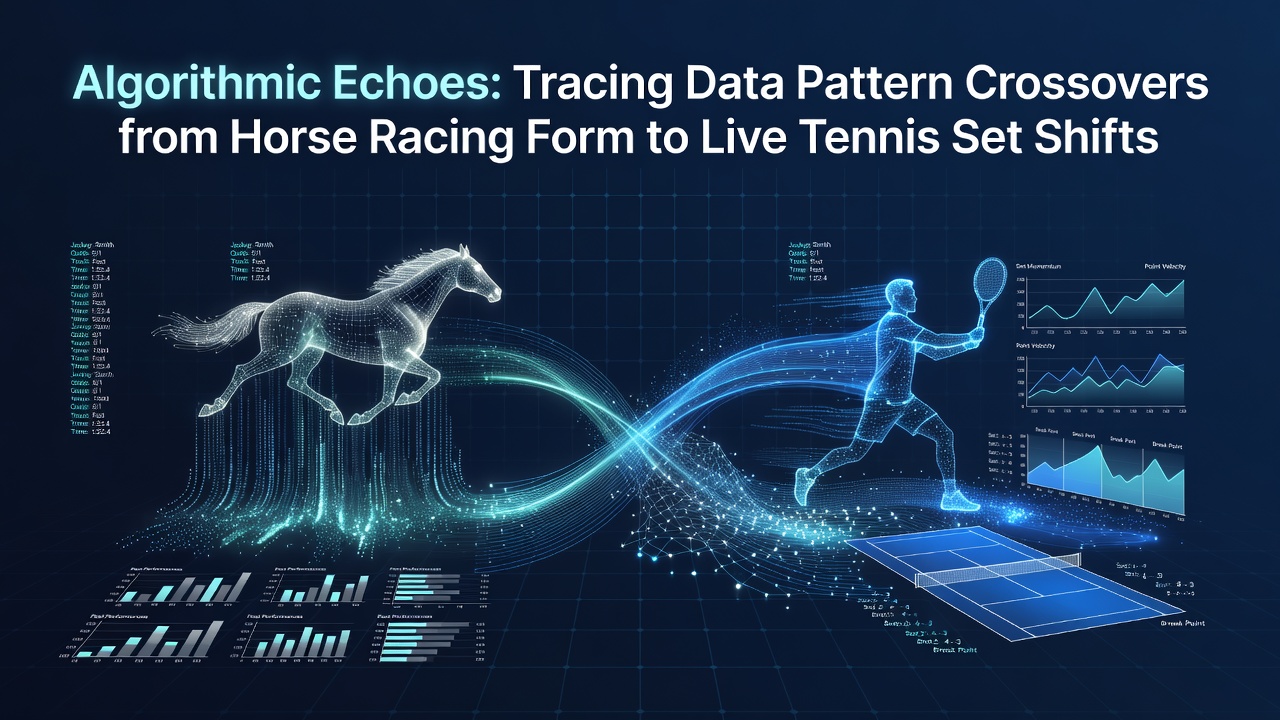
Analysts have long examined how statistical models built for one sport adapt to another, and horse racing provides structured datasets that transfer effectively to tennis analytics. Form guides in racing track variables such as pace ratings, jockey statistics, and surface conditions, while tennis set shifts record similar elements including serve percentages, rally lengths, and fatigue indicators. Researchers at academic institutions have documented these parallels through shared algorithmic approaches that process sequential performance data.
Pattern detection begins with historical records. Horse racing databases compile thousands of past runs per horse, allowing algorithms to identify repeating sequences before races. Tennis platforms apply comparable logic to match histories, where set-by-set breakdowns reveal momentum changes that mirror late-race surges in thoroughbred events. Data from August 2026 tournaments showed increased use of these cross-sport models among betting operators seeking efficiency in live markets.
Core Variables That Overlap
Several measurable factors appear in both domains. Track bias in racing corresponds to court surface effects in tennis. Early speed figures from horse races align with first-set dominance metrics. Fatigue accumulation, calculated through distance covered or points played, influences late-stage outcomes across both activities. Observers note that machine learning systems trained on one dataset often improve prediction accuracy when tested on the other because the underlying temporal structures share common traits.
Industry reports from regulatory bodies in Australia and Canada highlight growing adoption of hybrid models. These systems combine racing form inputs with tennis real-time feeds to flag potential shifts during live play. The process relies on supervised learning techniques that label successful crossovers and refine weights accordingly.
Implementation in Live Environments
Live betting platforms process streams of data where horse racing patterns inform tennis decisions in seconds. An algorithm might detect a late surge pattern from a prior racing card and apply it to a tennis player's comeback sequence in the third set. Such transfers occur because both sports feature discrete events that accumulate into larger trends.

Operators update models daily using fresh inputs. In August 2026, several European data providers released updated APIs that standardize variables across sports, reducing conversion time between formats. Those who maintain these systems report smoother integration when variables are normalized early in the pipeline.
Challenges in Cross-Domain Application
Direct transfers encounter obstacles. Racing occurs over fixed distances with clear physical markers, whereas tennis sets allow variable lengths and strategic adjustments. Algorithms must account for these differences through additional layers that adjust for sport-specific noise. Studies from research groups in the United States and the European Union demonstrate that unadjusted models lose accuracy when moved between domains without recalibration.
Data quality remains essential. Incomplete racing records or missing point-by-point tennis logs introduce errors that propagate through shared systems. Organizations address this through validation checks that compare outputs against independent benchmarks before deployment.
Future Developments and Integration
Continued refinement focuses on real-time adaptation. Newer architectures incorporate reinforcement learning that rewards successful pattern crossovers during live events. This approach allows systems to evolve based on outcomes rather than static historical fits alone. Trade associations in multiple regions track these advances and publish aggregated findings that guide further work.
Integration with broader analytics platforms expands the reach of these methods. Horse racing form engines now feed into multi-sport dashboards that include tennis, basketball, and other timed competitions. The connections strengthen as datasets grow and processing speeds increase.
Conclusion
Algorithmic echoes between horse racing form and tennis set shifts demonstrate how structured data from one domain supports analysis in another. Shared variables, calibrated models, and live processing pipelines form the basis for these transfers. Continued development depends on consistent data standards and validation across regions, with activity documented through 2026 showing steady expansion of hybrid techniques.